
Key facts
Hunters and others who spend time outdoors this fall are asked to report the locations of bear dens they might see in and around the Brainerd, Grand Rapids and Duluth areas.1
Researchers with the Minnesota Department of Natural Resources and the University of Minnesota Duluth hope to fit additional bears with GPS tracking collars this winter.1
The partners have teamed up because they say there has been an uptick in the number of unwanted bear encounters in the Duluth area, but noting such instances may happen in other regions across the state.1
Michael Joyce
Over the past two decades, more than 2,500 reports of bear conflicts have been reported in the area.1
Michael Joyce is a wildlife ecologist with the Natural Resources Research Institute at UMN Duluth.1
“So we’re just looking at really trying to better understand how bears are using the developed landscape, what some of the ecological factors are that influence where they go and what they do,” Joyce said.
The Duluth research project is funded, in part, by the Minnesota Environment and Natural Resources Trust Fund as recommended by the Legislative-Citizen Commission on Minnesota Resources.1
Collaring bears in Minnesota is not new.1
The DNR already has collared and is tracking bears, something it has done for decades in the Chippewa National Forest and the Brainerd area.1
One of the things it helps the department determine, including in the Brainerd area, is how old bears are when they first start reproducing.1
In turn, that can help hunters because monitoring the bear population helps the department determine harvest quotas.1
Hannah Leeper is a DNR wildlife research biologist.1
“In some parts of the state that age is shifting younger,” Leeper said.
What hunters should look for
Joyce said he’d like to know if bears are eating more food from gardens, bird feeders and even trash cans.1
Joyce said if those items factor into bears getting up to weight sooner and having their first litter earlier.1
“Bears reproducing at a younger age means there are more bears on the landscape and that can allow us to increase the harvest numbers in some of those areas,” Leeper said.
Minnesota’s collared bears have gone into their dens by now, according to Leeper.1
Leeper said that while it is safe to be out in the woods with a bear in its den, it is not a good idea to get too close to a den or peek inside.1
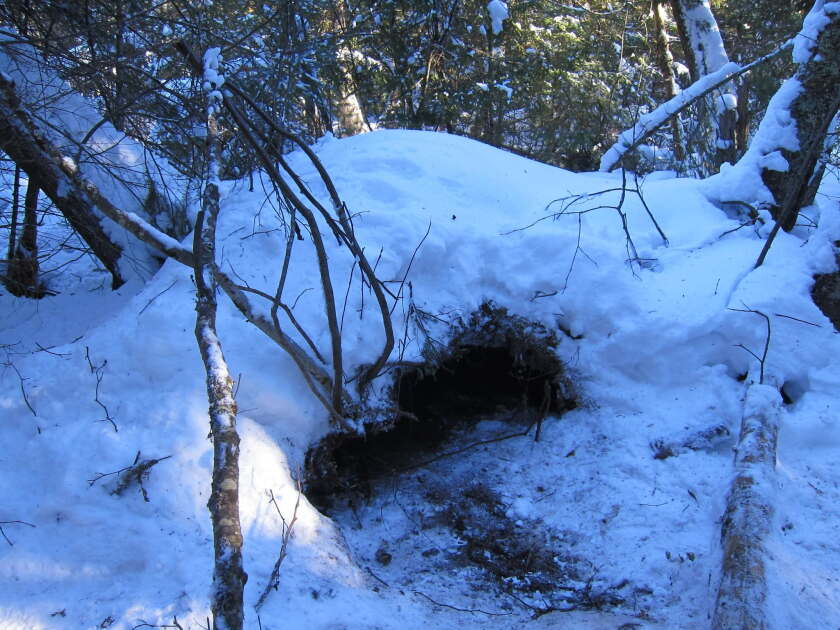
A bear den often looks like a hole in the ground, sometimes on a bank or what looks like a mound or ditch, but it could also be on a flat surface.1
Leeper said bears also use brush piles and human-made structures as dens.1
Leeper said that if people find what they think is a bear den, if they can, is basically get a picture of it and GPS coordinates.1
Leeper said sometimes stopping for a minute or two and listening might provide the sounds of a bear snoring or shifting its weight inside a den.1
In late January, a little cry might ensue from a den, letting the listener know a bear has given birth to a litter of cubs.1